When the Cerebral Cortex Forms Do Babies Automatically Feel Pain
Before the 1980s, clinicians actually performed surgery on newborns without giving them anaesthetics or pain medications. This wasn't considering they thought babies were completely incapable of feeling pain. But they didn't know how much pain the newborns could experience and feared that the medications may be too dangerous to warrant use.
Luckily we are amend informed today. As babies can't tell us how much pain they are in, scientists have invented several ingenious methods to try and piece of work out what they are feeling. But at that place's still a remarkable amount nosotros don't understand. And our new study, published in Current Biology, shows that we may exist underestimating how much pain babies feel when they are under stress.
The reason progress has been relatively slow is that there was for a long time no agreed method for reliably measuring babies' pain perception. It'southward but in the concluding few decades scientists take made increasing efforts to practise this – and the results may be applicable to other people who are unable to communicate too.
The first clues came from animal models in the early 1980s. These showed that the structural and functional connections inside the nervous arrangement required to perceive a painful event are present from nascence. However, we still do non know whether these connections are sufficiently mature for infants to experience pain in quite the same mode equally adults.
At the same fourth dimension, clinical investigators started exploring means of measuring pain in human infants. Following a painful process, such equally the heel stick used for claret tests (much like a finger prick used for developed claret tests), infants show several pregnant responses. These range from physiological (changes in heart charge per unit or breathing) and hormonal (release of the "stress hormone" cortisol) to behavioural (crying or grimacing).
All-encompassing research in this area suggested that baby pain should exist evaluated with a combination of these measures, leading to the development of neonatal clinical pain scoring systems, such equally the Premature Infant Pain Contour.
Pain in the brain
Another big advance in the field came from the Fitzgerald lab hither at University College London, which moved away from solely using observations of behaviour and physiological responses to measure hurting. Instead, it turned to the brain. We know that the perception of pain is generated by the central nervous system, so these researchers aimed to directly measure out the action of neurons (encephalon cells) that are responsible for the awareness of pain.
To do this, they used non-invasive measures similar electromyography (EMG) and electroencephalography (EEG), which measure the electrical activity generated by muscles and encephalon cells, following a painful event. This method has the reward of being both objective and quantitative, as it does not depend on observational scoring.
These studies confirmed that infants do procedure pain in the encephalon, only that they differ in their experiences with age. Kickoff, the lab recorded spinal reflexes – such as the withdrawal reflex, which is intended to protect the torso from damaging stimuli – and found that premature infants are more than sensitive to sensory stimulation than older infants. They subjected babies to repeated not-painful touches, and found that younger infants moved their limbs following lighter touches than older infants. In fact, the older infants got used to the repeated touches and eventually stopped moving their limbs.
They besides found that premature infants responded to both painful and non-painful bear upon with whole trunk movements. In older babies (at term age, effectually 40 weeks) this matured into more a purposeful withdrawal of the stimulated limb, becoming more specific to pain rather than any touch.
An of import next pace was to tape activity in the brain, which is where pain perception occurs. They did this with EEG, which uses electrodes placed on the scalp to track and tape brain waves. They plant that premature infants exhibited large bursts of encephalon activity which, as with early reflexes, are not specific to pain (a uncomplicated tap could produce a similar effect equally a heel prick). Towards normal term age (a few weeks prior), infants were more likely to show a clear pain-specific brainwave like to that seen in adults.
Even so, while this was a direct read out of what was happening in the nervous system after a painful outcome, you lot shouldn't assume information technology was a direct reflection of what the babe was feeling. This is because the feeling of hurting requires an emotional component as well as a sensory role, and although we can measure the sensory aspect, we tin not measure or make assumptions near the emotional processing in a newborn.
Stress and pain
In our latest research, my colleagues and I at the Fitzgerald lab focused on stress and pain. Many infants experience physiological stress as a result of necessary clinical procedures. For example, hospitalised babies often require several painful procedures a day every bit function of their care, and those who do not will likely feel events such as being weighed or loud noises (alarms) as stressful.
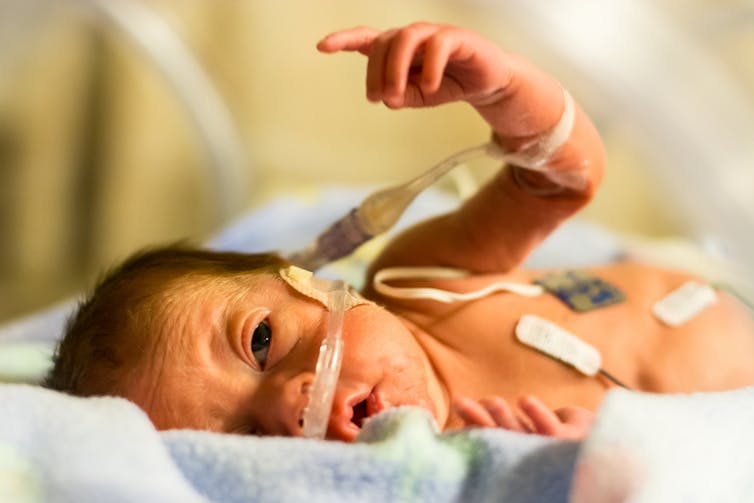
For the first time, nosotros measured both pain and stress at the aforementioned time as a single, clinically required blood test. In 56 hospitalised newborns, the hurting-related brain activity and behavioural response was measured following the claret examination, while the babies' groundwork level of stress was measured using the concentration of a stress hormone (cortisol) in the saliva and eye charge per unit patterns.
The results testify that for babies who are not stressed, a painful procedure volition often consequence in a coordinated increment in brain activity and behaviour, in the course of facial expressions. Babies who are more stressed have an even larger response in the brain post-obit a painful procedure, just, importantly, this is no longer matched by changes in behaviour. In other words, a stressed baby may have strong hurting-related action in their brain, but you could not tell that from simply observing their behaviour.
Since increased levels of stress can increase the amount of pain-related brain activity, it is clear that we should monitor and control the stress levels of hospitalised babies. Stressed babies may not seem to respond to pain although their encephalon is still processing it. The phenomenon has been seen in premature babies who sometimes "tune out" and get unresponsive when they are overwhelmed. But that doesn't mean they are not experiencing something. Importantly, this ways that doctors and nurses may underestimate their pain.
Given its huge importance, it may seem surprising that we know and so little about what newborns actually feel. Thankfully, inquiry is unravelling the mystery with impressive speed.
If yous're interested in learning more about pain, listen to our Anthill podcast episode on the topic here.
Source: https://theconversation.com/the-mystery-of-how-babies-experience-pain-88714
0 Response to "When the Cerebral Cortex Forms Do Babies Automatically Feel Pain"
Post a Comment